

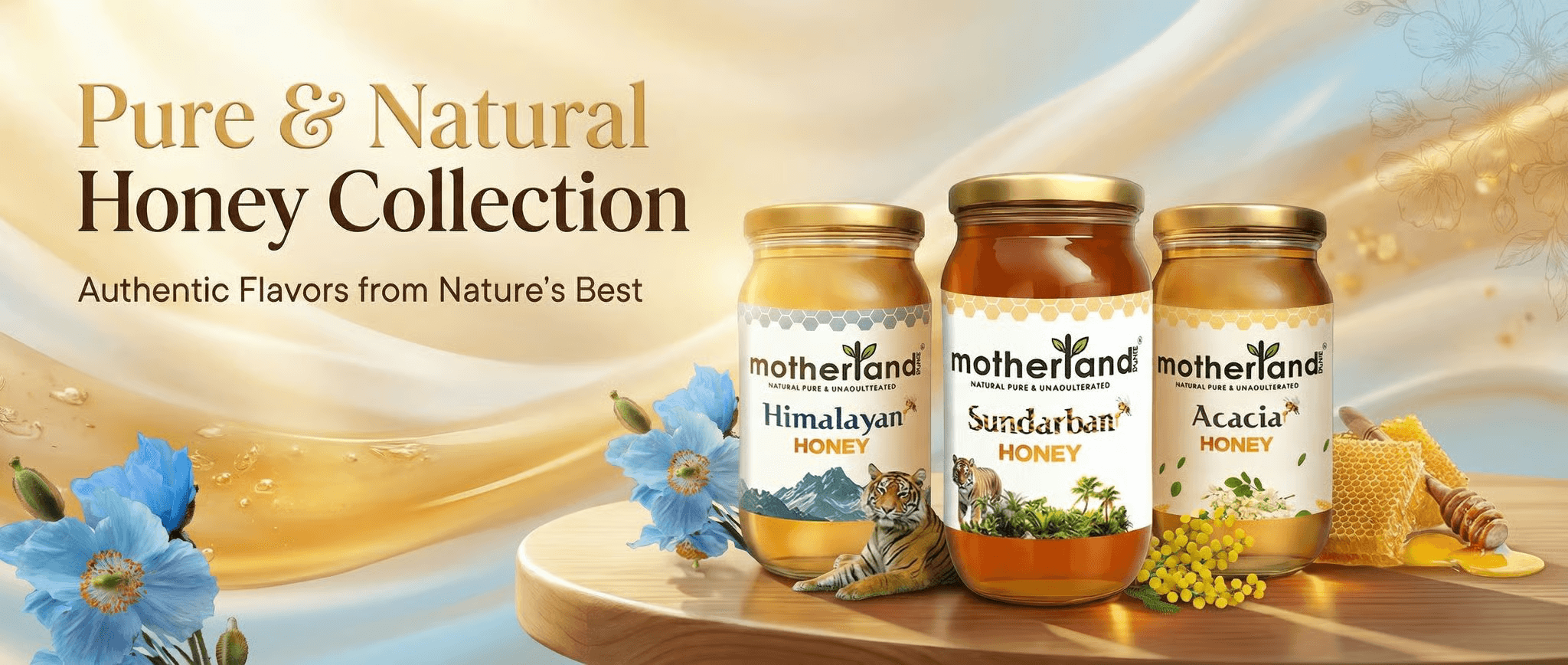
Honey has been a trusted natural superfood in Indian households for thousands of years. But today, not all honey sold in stores is created equal. If you've ever wondered why some honey stays perfectly clear and runny forever while others crystallize, or why raw honey has a stronger, more complex taste—the answer lies in one crucial distinction:
**The difference between raw honey and processed honey.**
Whether you're shopping for immunity support, natural wellness remedies, or simply replacing refined sugar with a healthier alternative, understanding raw vs processed honey is essential. In this comprehensive guide, we'll break down everything you need to know about raw honey benefits, how processing affects nutritional value, and how to identify high-quality raw honey for your family.
What Is Raw Honey? (Unpasteurized & Minimally Filtered)
**Raw honey** is honey in its most natural form—collected directly from beehives with minimal human intervention. It's the way honey has been consumed for centuries, before industrial processing became standard.
Characteristics of Raw Honey:
- **Minimally heated** (never pasteurized or heated above 95°F/35°C)
- **Lightly filtered** only to remove wax and bee parts
- **Never ultra-filtered** (retains beneficial pollen)
- **Rich in natural enzymes**, antioxidants, vitamins, and minerals
- **Contains bee pollen** and propolis traces
- **May appear cloudy** or slightly opaque
- **Crystallizes naturally** over time (a sign of purity)
- **Stronger, more complex flavor** with floral notes
The best raw honey comes from single-origin sources like Himalayan wildflowers, Sundarbans mangroves, or acacia forests, where bees collect nectar from specific flora, creating unique flavor profiles.
What Is Processed Honey? (Pasteurized & Ultra-Filtered)
**Processed honey** undergoes significant industrial treatment to achieve a uniform appearance and extended shelf life. Most supermarket honey brands use this method.
How Honey Gets Processed:
1. **High-temperature heating** (pasteurization at 160-170°F/71-77°C)
2. **Heavy filtration** or ultra-filtration (removes pollen completely)
3. **Sometimes blended** with honey from multiple sources or countries
4. **May include additives** like corn syrup in lower-quality products
Characteristics of Processed Honey:
- **Crystal clear** and transparent
- **Smooth, uniform texture** that stays runny
- **Delayed crystallization** (or never crystallizes)
- **Milder, less distinctive taste**
- **Reduced enzyme activity** due to heat exposure
- **Lower antioxidant levels** after filtration
- **Longer shelf appearance** (but not necessarily longer shelf life)
**Important clarification:** Not all clear honey is fake or adulterated. However, excessive processing does diminish the natural compounds that make honey valuable for health and wellness.
Is Raw Honey Healthier Than Processed Honey? (Science-Backed Answer)
**Short answer: Yes, raw honey is generally healthier and nutritionally superior.**
Here's why the difference between raw and processed honey matters for your health:
What You Get with Raw Honey (That Processed Honey Lacks):
1. **Active Enzymes**
Raw honey contains enzymes like diastase, invertase, and glucose oxidase that aid digestion and support metabolic functions. Heat processing destroys these delicate enzymes.
2. **Higher Antioxidant Levels**
Studies show raw honey contains significantly more polyphenols and flavonoids—compounds that fight oxidative stress and inflammation. Heating and filtration reduce these beneficial compounds by up to 30-40%.
3. **Natural Bee Pollen**
Raw honey retains trace amounts of bee pollen, which contains vitamins, minerals, proteins, and has immune-modulating properties. Ultra-filtration removes this completely.
4. **Antimicrobial Properties**
While both types have some antimicrobial activity, raw honey's hydrogen peroxide content and active compounds remain intact, making it more effective for wound care and throat soothing.
5. **Prebiotic Benefits**
Raw honey contains oligosaccharides that feed beneficial gut bacteria, supporting digestive health.
When Raw Honey Is Especially Beneficial:
- **Immunity support** during seasonal changes
- **Natural cough and throat relief** (better than processed alternatives)
- **Digestive wellness** and gut health
- **Energy boost** for fitness enthusiasts
- **Sugar replacement** in health-conscious diets
- **Traditional Ayurvedic remedies** (raw honey with warm water, turmeric, etc.)
Why Processed Honey Stays Runny Longer:
1. **High-temperature heating** breaks down glucose crystals temporarily
2. **Ultra-filtration removes pollen particles** that act as crystallization nuclei
3. **Blending** multiple honey types can slow crystallization
4. **Some brands add glucose syrup** to prevent crystallization (this is adulteration)
Factors That Affect Crystallization Speed:
- **Glucose to fructose ratio:** Higher glucose = faster crystallization
- **Floral source:** Acacia honey (low glucose) stays liquid; Jamun honey (high glucose) crystallizes faster
- **Storage temperature:** Honey crystallizes fastest at 50-59°F (10-15°C)
- **Pollen content:** More pollen particles = faster crystallization
**Bottom line:** If your honey crystallizes, that's actually a good sign! It indicates minimal processing and authenticity.
Does Raw Honey Crystallize? (And Should You Be Happy About It?)
**Yes—and you should celebrate it!**
Raw honey crystallization is one of the most reliable indicators of purity and minimal processing. Here's what you need to know:
Why Raw Honey Crystallizes:
- **Retains natural pollen** that acts as nucleation sites for crystal formation
- **Lower processing temperatures** preserve glucose structure
- **No ultra-filtration** means natural particles remain
- **Single-origin sources** often have higher glucose content
**Pro tip:** Never microwave crystallized honey! Gently warm the jar in hot (not boiling) water to return it to liquid form without destroying beneficial compounds.
Raw Honey vs Processed Honey: Taste & Texture Differences
Beyond health benefits, the sensory experience of raw versus processed honey is dramatically different.
Raw Honey Taste Profile:
- **Complex flavor** with distinct floral, earthy, or woody notes
- **Varies by source:** Acacia (mild, delicate), Forest honey (bold, robust), Tulsi (herbal)
- **Stronger aroma** that reflects the flowers bees visited
- **Natural aftertaste** that lingers pleasantly
- **Thicker, more viscous** texture (especially when crystallized)
- **Slightly grainy** when crystallized (this is normal and desirable)
Processed Honey Taste Profile:
- **Uniform, predictable sweetness** across batches
- **Mild flavor** with less character
- **Minimal floral notes** or aroma
- **One-dimensional** sweetness without complexity
- **Thin, pourable** consistency
- **Smooth texture** with no variation
**For honey connoisseurs:** Raw honey offers a tasting experience similar to wine—each batch tells the story of where and when it was harvested. Processed honey sacrifices this uniqueness for consistency.
Who Should Definitely Choose Raw Honey?
Raw honey is particularly beneficial for:
1. **Health-Conscious Families**
Parents looking to boost their children's immunity naturally and reduce sugar consumption.
2. **Fitness Enthusiasts**
Athletes and gym-goers who need natural energy and faster recovery (raw honey before/after workouts).
3. **People with Digestive Issues**
Those seeking prebiotic support and natural digestive enzymes.
4. **Sugar-Conscious Individuals**
People managing blood sugar levels (raw honey has a lower glycemic impact than refined sugar).
5. **Premium Food Lovers**
Those who appreciate artisanal, single-origin, and terroir-driven foods.
6. **Traditional Medicine Practitioners**
Ayurveda and holistic health practitioners who use honey medicinally.
7. **Environmentally Conscious Consumers**
Buyers who want to support sustainable beekeeping and biodiversity.
How to Identify and Buy High-Quality Raw Honey (8-Point Checklist)
Not all products labeled "raw" truly are. Here's how to ensure you're getting authentic raw honey:
1. Check for Crystallization Potential
If honey has been on the shelf for months and is still perfectly clear, question its rawness.
2. Look for Single-Origin Labels
Genuine raw honey specifies its source: "Himalayan wildflower," "Sundarban mangrove," "Acacia blossom."
3. Read the Ingredient List
Should say: "100% Pure Raw Honey" or "Raw Honey" only. Nothing else.
4. Verify Certifications
Look for FSSAI license, organic certifications, or NMR testing certificates (proves purity).
5. Check Brand Transparency
Reputable brands share information about their beekeepers, sourcing regions, and harvesting methods.
6. Examine Packaging
Raw honey is often sold in glass jars (better preservation) rather than plastic squeeze bottles.
7. Understand Pricing
Authentic raw honey costs more than mass-market processed honey. Be wary of unusually cheap "raw" honey.
Motherland Pure Honey: Authentic Raw Honey Varieties
If you're ready to experience the difference that genuine raw honey makes, explore Motherland's premium collection. Each variety is sourced from specific regions in India, minimally processed, and tested for purity.
**Acacia Honey** (Light & Delicate)
- **Taste:** Mild, soft, subtly sweet
- **Best for:** Daily wellness, children, mixing in beverages
- **Crystallization:** Very slow (stays liquid naturally)
- **Origin:** Acacia plantations in northern India
**Jamun Honey** (Deep & Medicinal)
- **Taste:** Bold, slightly tangy, deep caramel notes
- **Best for:** Diabetic-friendly diets, digestive health, traditional use
- **Crystallization:** Very fast (highly pure)
- **Origin:** Jamun (Black Plum) orchards
Final Verdict: Why Raw Honey Wins Over Processed Honey
After comparing raw honey and processed honey across health benefits, taste, nutritional value, and authenticity, the winner is clear:
**Raw honey is the superior choice for anyone who values their health and wants real nutritional benefits—not just sweetness.**
**The bottom line:** Raw honey is closer to nature, richer in beneficial compounds, and performs better for your body. Processed honey might look prettier on shelves, but raw honey delivers actual wellness results.
When you choose raw honey, you're not just buying a sweetener—you're investing in a superfood that has supported human health for millennia.
Explore Our Raw Honey Collection
Frequently Asked Questions (FAQ) About Raw vs Processed Honey
1. Is raw honey safe to eat every day?
Yes, raw honey is safe for daily consumption by adults and children over 12 months old. Recommended serving: 1-2 tablespoons per day. Raw honey contains natural enzymes, antioxidants, and antimicrobial properties that support wellness. However, infants under 12 months should not consume any honey (raw or processed) due to botulism risk.
2. Does raw honey ever expire or go bad?
No, pure raw honey has an indefinite shelf life when stored properly. Archaeologists have found edible honey in ancient Egyptian tombs over 3,000 years old! Honey's low moisture content and natural acidity prevent bacterial growth. Store in a sealed container at room temperature away from direct sunlight. Crystallization is not spoilage—it's a natural process.
3. Is crystallized honey spoiled or unsafe?
Absolutely not. Crystallization is a natural sign of pure, minimally processed honey. It indicates the honey hasn't been overheated or ultra-filtered. Crystallized honey is completely safe and retains all nutritional benefits. To return it to liquid form, gently warm the jar in hot (not boiling) water. Never microwave, as high heat destroys beneficial enzymes.
4. Can I add raw honey to hot tea or coffee?
Yes, but let your beverage cool slightly first. Adding raw honey to boiling-hot liquids (above 104°F/40°C) can degrade its delicate enzymes and reduce health benefits. For maximum nutritional value, wait until your tea or coffee reaches a comfortable drinking temperature before stirring in raw honey. The taste and sweetness remain unchanged.
6. Why is raw honey more expensive than regular honey?
Raw honey costs more because:
- **Small-batch production** from trusted beekeepers
- **No industrial processing** (saves costs for mass producers)
- **Single-origin sourcing** (not blended commodity honey)
- **Higher quality standards** and testing
- **Better beekeeping practices** (ethical, sustainable)
- **Superior nutritional content** justifies premium pricing
- **True value:** You're paying for actual health benefits, not just sugar
7. Can diabetics consume raw honey?
Raw honey has a lower glycemic index (GI of 45-58) compared to white sugar (GI of 65), meaning it causes a slower blood sugar rise. However, it's still a source of carbohydrates and should be consumed in moderation by diabetics—always consult your healthcare provider first. Jamun honey is traditionally recommended in Ayurveda for sugar-conscious diets, but medical supervision is essential.
8. How should I store raw honey to maintain quality?
Follow these storage tips:
- **Room temperature:** Store at 64-75°F (18-24°C)
- **Sealed container:** Prevent moisture absorption
- **Avoid refrigeration:** Cold accelerates crystallization
- **Away from sunlight:** UV light can degrade nutrients
- **Clean utensils only:** Moisture and contaminants affect quality
- **Original glass jar:** Best preservation method
About Motherland Pure
Motherland is committed to bringing you the finest raw honey directly from ethical beekeepers across India. Every jar is NMR tested, minimally processed, and sourced from single-origin locations to ensure you receive maximum health benefits in every spoonful.
**Our Promise:**
100% Pure, Raw, Unprocessed Honey
No Additives, No Added Sugar, No Heating
Single-Origin Sourcing with Full Transparency
Laboratory Tested for Purity (NMR Certified)
Supporting Sustainable Beekeeping Practices
Premium Quality at Fair Prices