

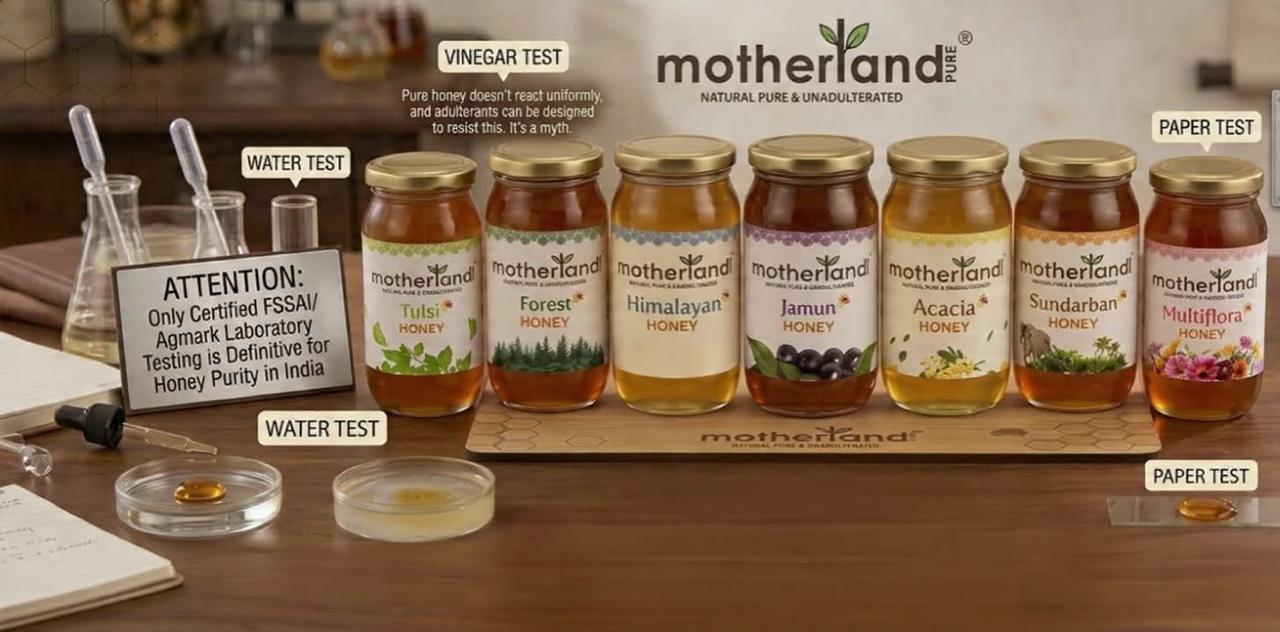
Walk into any supermarket in India and you'll see dozens of honey jars, every single one stamped "100% pure." But that stamp doesn't mean what most people think it means.
A well-known investigation by the Centre for Science and Environment found that a large majority of Indian honey brands failed purity tests — many were cut with cheap sugar syrups, others put through a process called ultra-filtration that strips out pollen and enzymes, leaving something that's honey in name only and syrups that standard FSSAI tests struggle to catch. If you've ever wondered whether the jar in your kitchen is the real thing, you're not being paranoid. You're asking the right question.
This guide walks through what actually proves honey is pure, what doesn't, and what to look for the next time you buy.
Why the Water, Flame, and Thumb Tests Don't Work
If you've spent any time on Instagram or WhatsApp, you've probably seen one of these "purity hacks":
- Drop honey in water — if it sinks, it's pure.
- Hold a flame to it — if it burns, it's pure.
- Rub a drop between your fingers — if it doesn't turn sticky, it's pure.
None of these are scientifically reliable. Honey's behavior in water, its flammability, and its stickiness are all affected by moisture content, temperature, and how the honey was processed — not just by whether sugar syrup was added. A partially processed honey can fail these tests and still be pure. A well-adulterated one can pass them and still be fake.
The uncomfortable truth: you cannot verify honey purity by eye, touch, or a kitchen trick. It takes a lab.
What Actually Proves Purity
Real purity testing looks at the honey's chemical composition, not its appearance. A few methods worth knowing:
- NMR (Nuclear Magnetic Resonance) profiling — considered one of the most reliable methods for detecting adulteration, including sophisticated syrup blends that are hard to catch with older tests.
- Sugar adulteration tests (like C3/C4 testing) — check whether cane or corn sugar syrup has been mixed in to bulk up the honey.
- FSSAI and Agmark-aligned testing — India's regulatory benchmarks for food safety and quality standards.
None of these are things you can do at home. They require accredited lab equipment and trained technicians — which is exactly why "lab tested" should mean something, not just be a phrase printed on a label.
Raw Honey vs Processed Honey — What's the Real Difference?
Raw honey is honey as it comes out of the hive, with minimal filtering and no heating. It retains its natural enzymes, pollen, and the slightly cloudy texture that comes with that.
Ultra-filtered honey — common among mass-market brands — is heated and forced through fine filters under pressure. This strips out pollen (making the honey's origin untraceable) and destroys the natural enzymes that give raw honey its nutritional edge. What's left is honey that looks perfectly clear and never crystallizes — which sounds appealing, but is actually a sign of heavy processing, not quality.
Speaking of crystallization —Does Real Honey Crystallise?
Yes. This is one of the most common purity myths — that crystallized honey has "gone bad" or is fake. It's the opposite: crystallization is a natural process driven by glucose content and storage temperature, and raw, minimally processed honey often crystallizes faster than heavily heated honey. If your honey has never once crystallized, that's worth questioning — not the other way around.
What to Check on the Label Before You Buy
Since you can't test honey yourself, the next best thing is knowing what a transparent brand actually shows you. Before buying, check for:
- Manufacturer details — a real name and address, not just a brand logo
- Batch number — traceability matters; brands that hide it usually have a reason to
- Manufacturing and expiry dates
- Applicable certification marks (FSSAI is mandatory in India; look for it clearly stated)
- Ingredient transparency — does the label say "honey," or does it list additives?
Brands willing to share this information — rather than leaning only on buzzwords like "100% pure" — are generally the ones being straight with you.
Where Motherland Pure Fits
At Motherland Pure, our honey — including our Himalayan and Jamun varieties — is lab tested for purity, and every batch is backed by our FSSAI food safety registration. We built our brand on one line, and we mean it literally: Nothing Added. Nothing Removed. Just Nature.
We'd rather you ask questions than take our word for it. If you want to know more about how our honey is sourced or tested, send us a message — we're happy to talk you through it.
The Bottom Line
Honey purity isn't something you can eyeball, and it isn't something a viral kitchen trick can prove either way. It comes down to sourcing, processing, and testing — and a brand's willingness to be transparent about all three. The next time "100% pure" is stamped on a jar, it's worth asking: pure according to whom?
Shop Motherland Pure's Himalayan and Jamun honey — raw, lab tested, and made with nothing but nature. [Shop Now → https://motherlandpure.com/product/himalayan-raw-honey?visualId=PURE-HIMALAYAN-HONEY-1769077641501 ]