

Honey Is Not Just Honey
A Founder’s Note on Transparency, Sourcing & Informed Choice
When we first began working with honey sourcing in Uttar Pradesh, we believed what most people
believe — honey is honey.
Sweet. Golden. Natural.
It sat on our breakfast tables, stirred into chai, added to warm water in the mornings. As long as the
label said “pure,” we rarely questioned it.
But the deeper we went into floral origins, laboratory testing standards, and the realities of honey
processing in India, the more we understood something important:
Honey is not a generic pantry item.
It is a botanical product shaped by origin, handling, and transparency.
And assuming all honey is the same can lead to uninformed choices.
This blog is not written to create alarm.
It is written to encourage awareness.
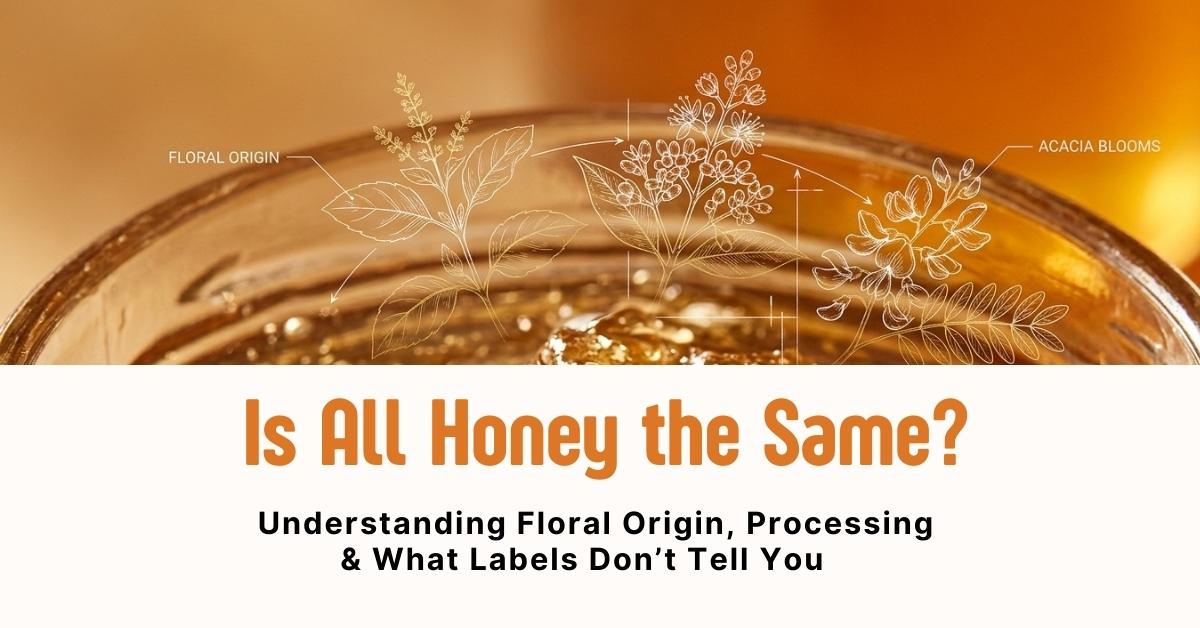
Floral Origin Is Not Marketing — It’s Science
Honey begins with nectar. The flowers bees forage from directly influence honey’s flavour, colour,
aroma, and composition.
Broadly, honey can be:
• Monofloral — predominantly derived from one floral source
• Multifloral — collected from a variety of seasonal blooms
This difference is not cosmetic.
Floral source can influence:
• Colour intensity
• Viscosity and crystallisation behaviour
• Aroma compounds
• Naturally occurring antioxidants
• Subtle variations in sugar profile
That is why two jars labelled “pure honey” may taste entirely different.
Floral origin does not make one honey medicinal and another ordinary.
It shapes character — not miracles.
Processing: The Invisible Factor
Raw honey naturally contains enzymes such as invertase and diastase. These enzymes are
sensitive to excessive heat.
Some large-scale processing methods use higher temperatures to delay crystallisation or
standardise texture. While this does not make honey unsafe, it can alter certain natural
characteristics.
Filtration practices vary as well.
Ultra-filtration produces extremely clear honey.
Minimal filtration retains more natural components.
And crystallisation — often misunderstood — is a natural process influenced by glucose levels and
storage temperature. It is not spoilage. In fact, many minimally processed honeys crystallise over
time.
Understanding processing helps consumers move beyond label assumptions.
Why Transparency Matters in India
Honey adulteration has been documented in India through food safety investigations and
independent testing reports. Sugar syrups and other additives have at times been used to increase
volume.
Yet most jars on shelves look nearly identical — offering little insight into floral source, testing
standards, or handling practices.
We believe food should not require blind trust.
Responsible producers typically conduct:
• Purity analysis
• Moisture testing
• Sucrose level verification
• Antibiotic residue screening
Transparency should not be an afterthought in something consumed daily.
For us, clarity in sourcing and testing is foundational — not promotional.
What Research Actually Says
Natural honey contains phenolic compounds and antioxidants.
Research has studied honey for:
• Its soothing role in cough management
• Its antimicrobial properties
• Its application in medical-grade wound care
Studies indexed in the National Library of Medicine have explored honey’s role in cough relief
compared to placebo.
But responsible communication matters.
Honey is not a cure.
It is not a replacement for prescribed treatment.
And exaggerated claims weaken consumer trust.
Honey can be part of a balanced diet — not a miracle solution.
Choosing Becomes Personal
Once we understood that floral origin truly shapes honey, offering a single “generic” variety no
longer felt honest.
Each floral source carries its own sensory identity:
• Himalayan: Robust, high-altitude depth.
• Acacia: Mild, smooth, slow to crystallise.
• Tulsi: Gentle herbal notes.
• Forest: Earthy, wild layers.
• Jamun: Dark, tangy richness.
• Sundarban: Bold coastal character.
This is not about superiority.
It is about informed choice.
Choosing becomes less about “which is best” and more about “which suits your daily ritual.”
Responsible Consumption
A transparency movement must also include clarity around safety:
• Honey should not be given to infants under one year of age due to the risk of infant botulism.
• Individuals managing diabetes should account for honey within total carbohydrate intake.
• Honey should not replace prescribed medical treatment.
• Therapeutic use should be discussed with a qualified healthcare professional.
Balanced communication builds lasting trust
Simple Belief
When honey is treated as a generic sweetener:
• Floral diversity is overlooked
• Processing differences are ignored
• Testing standards are rarely discussed
We believe consumers deserve better than assumptions.
Honey may look simple in a jar.
But its journey — from flower to bottle — is layered, botanical, and deeply influenced by
transparency.
For us, honey is not positioned as a cure.
It is an everyday ritual.
And when something becomes part of your daily life, quality should never be optional.
Explore Our Floral Varieties
Choose with awareness. Choose with clarity.